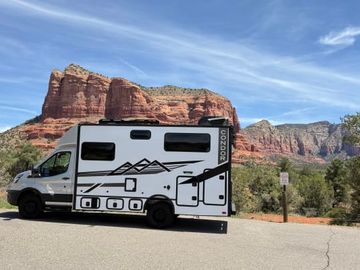
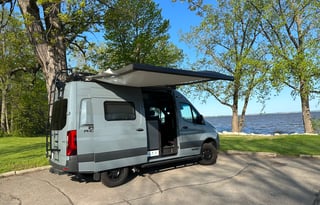
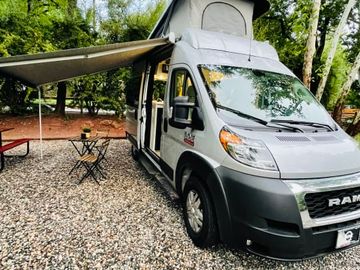
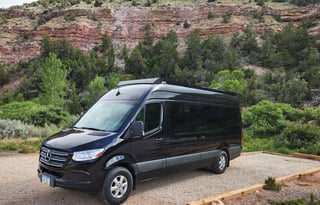






The van season in Phoenix runs opposite to most of the country. The Valley sits at roughly 1,100 feet in the low Sonoran Desert, and the 1991-2020 climate normals put the July average high near 106°F with an average overnight low around 85°F. A camper van's roof air conditioner needs shore power; on the house battery alone it will not run through the night. That single constraint sets the calendar here. Roughly October through April is the comfortable stretch, and May through September is a trip you plan around the heat rather than through it.
In summer you drive uphill, not far
The escape from a Phoenix summer is elevation, and it is closer than most visitors expect. If the high country is the whole point of the trip, compare campervan rentals in Flagstaff before committing to a Valley pickup.
- Payson and the Mogollon Rim: about 89 miles up SR 87, the Beeline Highway, in under two hours. Payson sits near 5,000 feet; the Rim Lakes Recreation Area on top of the Rim, reached by Forest Road 300, is closer to 7,700 feet. Rim and Mogollon campgrounds near Woods Canyon Lake put part of their sites on recreation.gov and leave the rest first come. Knoll Lake Campground takes no reservations at all and runs roughly late April into September. Most Rim forest roads close for winter.
- Prescott: about 99 miles, well under two hours, at roughly 5,400 feet.
- Flagstaff: about 145 miles on I-17, around two and a half hours, at roughly 7,000 feet, where July highs sit in the low 80s.
- The White Mountains: Show Low near 6,400 feet and Pinetop-Lakeside near 7,000 feet, about three and a half hours out.
I-17 climbs close to 5,800 feet between Phoenix and Flagstaff, including sustained six percent grades. A loaded van takes those slowly, so budget more time than the mapping app quotes and expect company on summer weekends.
Monsoon changes how you pick a campsite
Arizona's monsoon season is defined as June 15 through September 30, and the heaviest storms usually land between mid-July and mid-August. Two rules matter more here than anywhere else you might take a van. First, do not camp in a wash or any low-lying spot; Arizona State Parks says so plainly, because a wash can flood from a thunderstorm you cannot even see. Second, do not drive around a barricade into water on a road. Arizona's ARS 28-910, known as the stupid motorist law, makes a driver who does that liable for the emergency response, up to $2,000 per incident. If a dust storm closes in, get well off the roadway and wait rather than driving into it.
Late spring is also fire-restriction season. Tonto and Coconino National Forests routinely move to Stage 1 or Stage 2 restrictions from around late May until monsoon rain lowers the danger, which bans campfires outside developed recreation sites. Check the current forest order before you plan a fire.
Winter is the peak season, and it fills
November through March is snowbird season across the Valley, and RV parks in Phoenix, Mesa and Apache Junction run near capacity from January through March. Three events stack onto that window: the Barrett-Jackson auction in Scottsdale in January, the WM Phoenix Open in early February, and Cactus League spring training from late February through March across ten Valley ballparks. If you want a full-hookup site in that stretch, book months out rather than weeks.
Lost Dutchman State Park, at the foot of the Superstitions in Apache Junction, is the closest good state-park option: 134 sites, 68 with water and electric, on paved roads. Arizona State Parks takes reservations up to 365 days ahead through its own system, and the campground fills through the January to mid-April peak.
Routes out, with the van-specific details
Sedona, about 115 miles and two hours north, is the trip most people take first. The free Sedona Shuttle runs Thursday through Sunday from park-and-ride lots to the Cathedral Rock, Soldier Pass, Dry Creek and Little Horse trailheads, and daily during some holiday and spring-break periods. When the shuttles run, those trailhead lots are closed to vehicles, which solves a real problem in a van. Camping west of Sedona along Forest Road 525 is now designated-site dispersed camping only, first come, with a 14-day limit on the Coconino.
Grand Canyon South Rim, about 230 miles and three and a half hours, is a straightforward drive on I-17 and SR 64. Mather Campground takes reservations up to six months ahead on recreation.gov, caps vehicles at 30 feet, has no hookups, and has a free dump station at Camper Services. Trailer Village is the in-park full-hookup option and handles pull-throughs up to 50 feet. Hermit Road is closed to private vehicles from March 1 through November 30, so you park the van and ride the free shuttle. The North Rim is a much longer drive from Phoenix, opens only for a summer season, and has been running reduced services since the 2025 Dragon Bravo Fire, so check the park's North Rim status page before counting on anything there.
Saguaro National Park, about two hours south at Tucson, has a detail worth knowing before you commit: the park has no drive-in campground at all. All six in-park campgrounds are backcountry, hike-in only. Van campers stay at Pima County's Gilbert Ray Campground near the west district instead. The road into the west district is limited to vehicles under 25 feet, while the Cactus Forest Loop Drive in the east district allows up to 35 feet.
The Apache Trail, SR 88 east of Apache Junction, is paved as far as Tortilla Flat and unpaved beyond it. A long closure past Fish Creek following 2019 flood damage has been partly undone, but conditions still shift with weather and rockfall. Most rental agreements restrict unpaved roads, so read yours before pointing a van up it.
Pickup and parking in the Valley
Sky Harbor sits unusually close to downtown, but van and RV suppliers are off-airport rather than in the rental car center. Expect a curbside pickup or a short shuttle to a depot in Mesa, Tempe or the near-airport area, and add an hour to your arrival plan. Phoenix is also a regular origin for one-way and relocation moves toward Las Vegas, Denver and Southern California, so a one-way is worth asking about if your route does not return to the Valley.
Do not plan to sleep on a Phoenix street. The city's zoning ordinance requires occupied recreational vehicles to be located in an RV park, and the city code limits how long a vehicle may sit in one place on a public right-of-way.