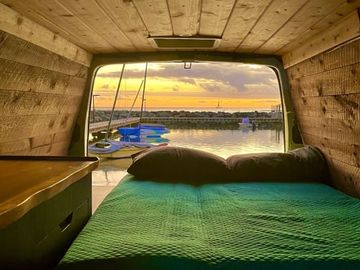
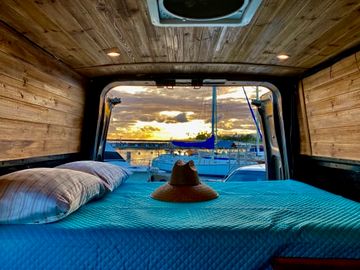
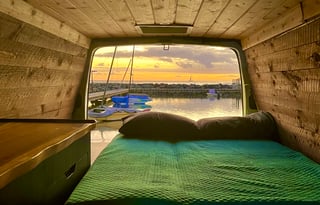

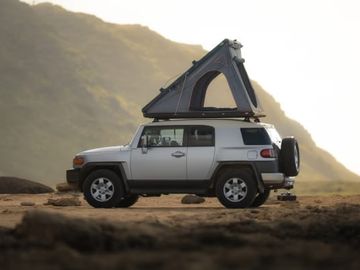
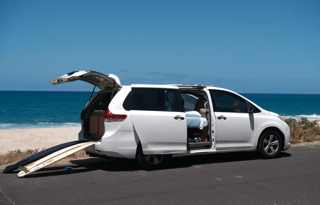








Dawn at Malaekahana comes through the ironwoods, with the tent pad a few steps from the sand and the trade wind already in the needles. You hear the set from camp before you see it.
Along the North Shore, a winter swell barrels at Pipeline in front of a line of spectators on the sand. Waimea Bay takes that winter swell too, and that water is closed to swimming.
Haleiwa sits between those beaches as the town stop, plantation-era wood storefronts and a shave-ice line before you drive back to the trees.
Winter, roughly November into April, is that swell, and it is also when the handful of North Shore campsites disappear. The overnight and the spectacle compete for the same dates, so hold the campsite before the van. From May through September the north-facing beaches go calm and swimmable, and the surf moves to the south and west shores. Trade winds blow onshore most of the year, and a Central Pacific storm can close county camping with little notice in late summer.
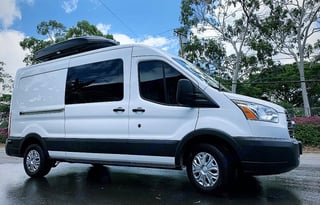
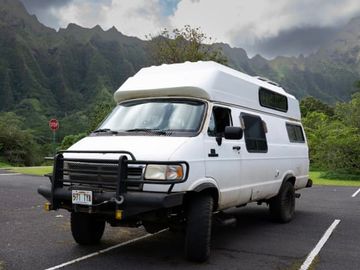
As of September 2026, the state's Kahuku section of Malaekahana is closed for an infrastructure rebuild. Friends of Malaekahana books primitive tent sites and cabins at Kalanai Point on its own site. If you need more sleeping space than a campervan, Honolulu RV rentals are the step up.
The paved road stops at Kaena Point. A wave-battered lava point takes the water, with albatross overhead and monk seals hauled out on the rocks below the trail. The trail follows the lava, and the road is already behind you. Oahu is one loop, and the road from the North Shore continues around to the windward pali with no need to double back across the island.
Kualoa, Hoomaluhia, and Waimanalo
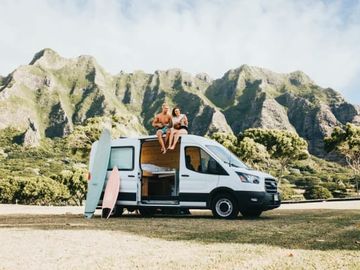
Kualoa Regional Park spreads a flat green pasture under the sheer Koolau pali, with the ocean on the other side of the grass. Kualoa Ranch sits next door, the valley film crews used for Jurassic Park, and that fame is what pulls people to this stretch of coast. The van sleeps at the county park, which closes from Memorial Day weekend through Labor Day weekend, so it is a school-year park rather than a summer stay.
Hoomaluhia Botanical Garden puts the campground under a rainforest canopy. Walk the paths, pass the koi ponds, and sleep with the Koolau pali over the lawns.
Waimanalo Beach Park holds a long reef-calmed lagoon. The reef takes the swell so the water along that beach stays easy. Camp on that beach and swim the lagoon. The sites take a five-day permit, so you can stay on that sand through a stretch of nights.
If Malaekahana is already booked, Hoomaluhia and Waimanalo are the usual first camps, reserved in advance on that same windward coast. Miss those and night one is lodging outside the campground system, because there is no walk-up permit anywhere on Oahu. On the leeward Waianae coast, Keaau Beach Park and Nanakuli Beach Park take those same county permits. It is a quieter shore than the winter North Shore.
Diamond Head, Pearl Harbor, and Waikiki
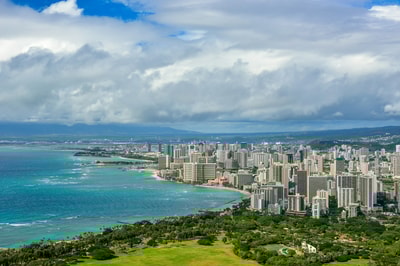
Waikiki's beach is a palm-lined strip of white sand with the high-rises stacked behind it. Walk the sand and get in the water, then be back at camp for the night.
Diamond Head's summit trail climbs through a tunnel and comes out on the crater rim. From there you look down into the crater and across to Waikiki, the high-rises and the beach in one view. Reserve the hike before you go.
Pearl Harbor is the other reserved morning in town. Book it ahead and drive in from camp, because there is no van overnight in the city.
For Maui, Kauai, and the Big Island, plus the statewide camping rules, start on the Hawaii campervan page.