

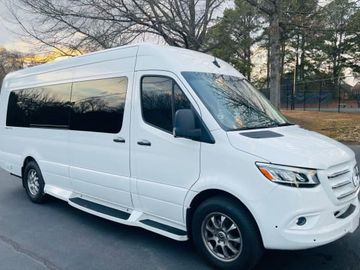
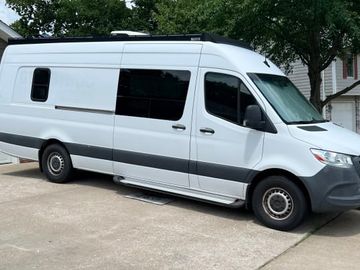
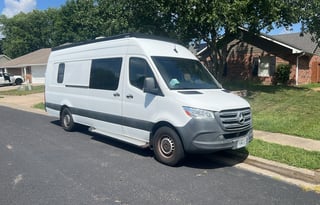
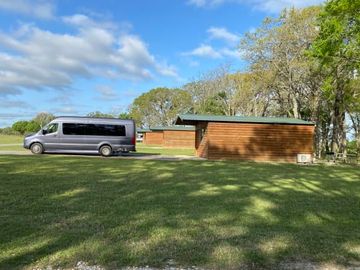










The campground loop at Lake of the Ozarks is in the trees above a cove, the water downslope and the far shore held by bluffs. Boat wake hits the rocks after breakfast, and the humidity is already on the leaves.
Stone castle ruins look over the spring at Ha Ha Tonka, a short drive from the lake loops. You walk the natural bridge under the bluff. Sinkholes and caves take the rest of the day, and you come back because Ha Ha Tonka has no campground.
Lake of the Ozarks State Park spreads four campground sections through those woods above the water. Sections 1 and 4 take basic and electric sites year-round, and they still take walk-ups when nobody has reserved the pad.
Book the site before the van when you want hookups in summer. A reserved weekend is a two-night minimum.
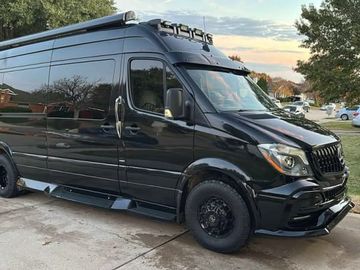
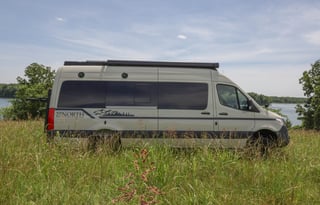
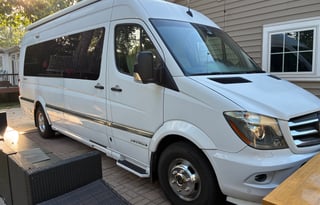
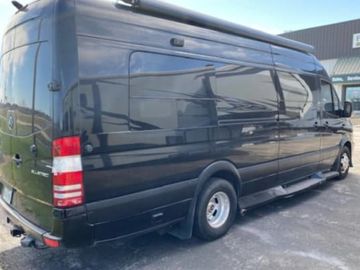
If you need more sleeping space than a van for a lake week, Missouri also has RVs for rent. Table Rock is the other lake weekend, down in the valleys toward Branson.
Table Rock Lake and Branson
Table Rock Lake is bluff water in Ozark Mountain valleys that run to the Arkansas line. The shore folds into coves, and Branson is the other half of the same weekend. The attractions fill with the lake, and campgrounds around town fill on those same weekends.
Table Rock State Park is the state-park loop on the water. The U.S. Army Corps of Engineers campgrounds on Table Rock book on Recreation.gov, and peak weekends go months ahead. If the trip keeps going south, Arkansas campervan rentals pick up below Table Rock.
Pomme de Terre State Park is the quieter Ozark lake, with campground areas at Pittsburg and Hermitage rather than one sprawling loop. Route 66 State Park has no campground. The visitor center is the former Bridgehead Inn, a 1935 roadhouse on the original road, and the overnight on that corridor is Onondaga Cave State Park near Leasburg.
The Katy Trail, Hermann, and the wine towns
The Katy Trail is 240 miles of crushed limestone on the old Missouri-Kansas-Texas Railroad from Clinton to Machens. The path follows the Missouri River bluffs past the river wine towns, with 26 trailheads and four restored railroad depots along the old line. You ride during the day and sleep at the city campground in Hermann. Hermann's city campground has 51 full-hookup sites and goes electric-only from mid-November to mid-March, so a winter ride still has a pad.
Mark Twain Lake and Hannibal
Mark Twain Lake is a Corps lake with open shoreline. Mark Twain State Park puts Badger, Coyote, and Puma on that shore with basic and electric sites. Mark Twain Cave is a limestone mouth at the edge of Hannibal, and the cave campground in town is the other night, next to the tours and downtown. The lake and the cave town share the name and split the nights.
Bennett Spring, Roaring River, and Montauk
Bennett Spring near Lebanon, Roaring River near Cassville, and Montauk near Salem run as a set. The water is spring-fed and clear enough to see the trout from the bank. Opening morning stacks anglers at first light, and those three parks are the busiest they get.
Bennett Spring has five campgrounds and Roaring River three, so a van gets a pad even on opening weekend if it is booked ahead. Montauk's loop is basic and electric only, so a full-hookup night belongs at Bennett Spring or Roaring River.
St. Louis and Kansas City
From St. Louis the trip is the St. Francois Mountains, Meramec, and the Riverways around Eminence, on the St. Louis campervan page. Kansas City is the Missouri River north and Truman Lake, on the Kansas City campervan page. Columbia, Jefferson City, and Springfield are in-state names on those drives, and Illinois campervan rentals continue across the Mississippi.