

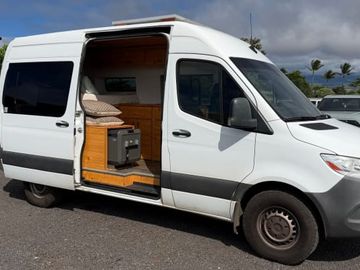
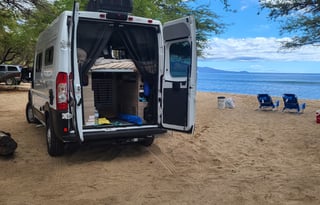
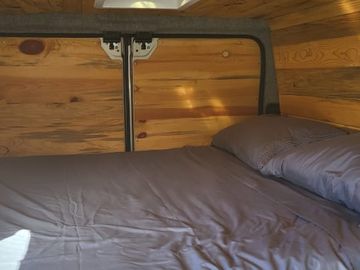

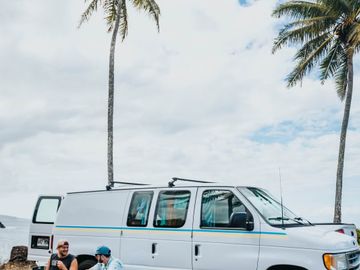
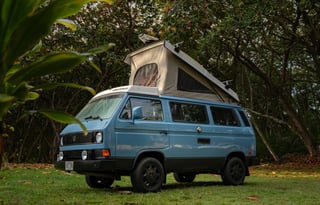
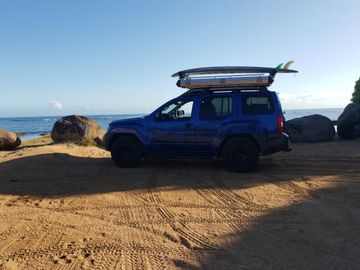








The Hana Highway makes you wait your turn at one-lane bridges when they are occupied, waterfall pullouts are already full, and rainforest closes over the van. More than 600 curves sit under that canopy, and the windshield drips even in a light rain. You eat at a pullout, wait out a rain squall, and roll on when it clears, stopping when the light is good. Give it a full day out, a night, and a slower morning after those curves, and pull off when a waterfall shows.
Black lava sand, sea arches, and blowholes sit at Waianapanapa State Park, past the town of Hana itself, at the far end of Maui's Hana Highway. You sleep there so morning starts on that sand, with the blowholes still working the shelf. Waianapanapa's campervan camping category is the permit a van books, so book the pad before the van. Entry and camping are separate reservations, day-use is bookable up to 30 days ahead as of September 2026, and visitors without a slot are turned away, while Hawaii residents with ID skip the non-resident entry reservation.
Past Hana, the road reaches Kipahulu Campground inside Haleakala National Park, about 10 miles on, near the Seven Sacred Pools. Rainforest and a stream sit at this end of the same highway. This is the other end-of-road night, and you reserve a site before you go.
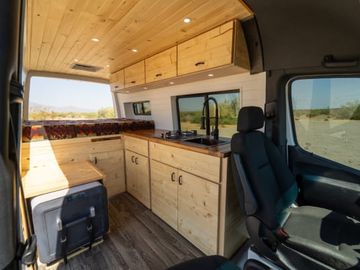
The windward side takes more rain and a rougher surf in winter, and summer eases the stream crossings on this side of the island. Starting from the west side without a pad reserved at Waianapanapa or Kipahulu is a long day on this road. If you need more sleeping space than a campervan layout, Maui RV rentals list larger floorplans on the same island. Haleakala's crater is the other overnight to plan.
Haleakala summit and Hosmer Grove
The crater bowl and cinder cones sit above the cloud line at Haleakala. Pre-dawn the rim is wind and dark. Then the bowl shows, often with a layer of cloud sitting below you. You camp high the night before for that morning.
Hosmer Grove sits near 7,000 feet, already inside the park and on the rim above that bowl. Reservations are required, $20 a night with a three-night max as of September 2026. Sunrise viewing comes with the site. Nights at the summit sit near freezing in every month, even when the beaches are warm, so pack a warm layer for the rim.
Vehicles entering the summit between 3 and 7 a.m. need a sunrise reservation on Recreation.gov, one per vehicle, bookable up to 60 days ahead and no later than two days out as of September 2026.
Camp Olowalu and West Maui
Ironwoods shade a West Maui beach at Camp Olowalu, and in winter humpback whales spout offshore from camp. December through May is the window for those spouts. This is the practical first night on the west side, because the Hana Highway is a long east-side day from here. You can reach Olowalu at the start of the week and save Hana for a night you have already reserved.
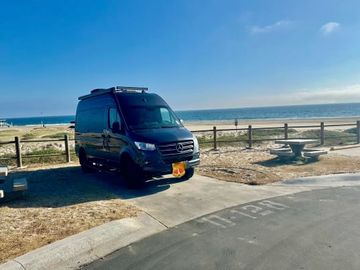
Camp Olowalu runs a car-camping tier with no hookups. You are in the trees, on the sand, watching the channel.
Papalaua Wayside Park is the county overflow when Olowalu is full. Camping there is closed Tuesdays and Wednesdays.
Iao Valley State Monument is a day stop inland. The Needle is a fluted green spire off the valley floor, and you need a day-use reservation to walk in.
West Maui is still recovering from the August 2023 fire, and Lahaina should be treated as closed to sightseeing.
For the other Hawaiian islands and the statewide camping-permit rules, use the Hawaii campervan hub. A van does not move between islands.