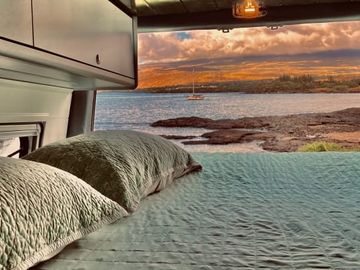
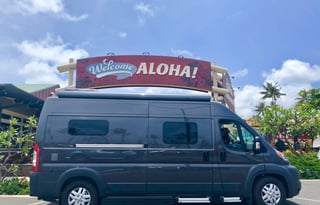
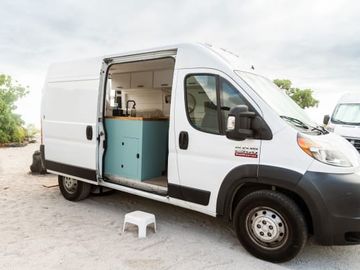








Steam lifts off Halemaumau and hangs in the ohia along the caldera rim. You walk that edge in a jacket while the coast is still in shorts weather, and the boardwalk is warm underfoot. Kilauea erupts in episodes, so the rim you walk is the rim that week.
Chain of Craters Road leaves the rim and runs down across black lava, old flows stacked on older ones, all the way to a coast where the rock drops into the ocean. There are no trees on that descent. You drive a black slope with mist at the top and salt air at the bottom. You can walk the rim in the morning, when the steam shows, and spend the afternoon on the lava road as it opens toward the water.
Namakanipaio sits back in that rainforest, ohia and fern closing around the pads so you hear the weather more than you see a view. Rain on the Hilo side shows up most days, a shower more than a storm, and it often arrives after dark, so you pack for daily rain here rather than a dry season. Nights at the rim run cold in any month, even when the beaches are warm, because the crater sits above four thousand feet and the forest holds that chill after dark. You sleep in those trees so the crater is a walk at dusk and again at dawn. On busy weeks, lock a site before you book the van. The park's drive-up sites are tent pads, so if you need more sleeping space than a van, Hawaii RV rentals are the size up.
If the tent pads are gone, cabins book by phone through Hawaii Volcanoes Lodge Company, two cabins per guest. Kulanaokuaiki is the overflow campground inside the park. Saddle Road climbs from this volcano country toward Mauna Kea when you want the night sky.
Mauna Kea and the Visitor Information Station
The Visitor Information Station sits at 9,200 feet among cinder cones. After dark the cones are silhouettes and the star field is dense. The air is thin and sharp, and the lot can drop to freezing with a hard wind in any month.
The road above the station is four-wheel drive, and two-wheel-drive rentals are prohibited past the Visitor Information Station as of September 2026. A campervan stops at the station. Give it a half hour in the lot before you walk far, then stay into the dark and sleep somewhere else.
From the station, Saddle Road drops toward Hilo and the Hamakua coast, a long descent from the high lot into rainforest on the wet side of the island. Kalopa State Recreation Area is the quieter overnight on that side, drive-up pads and cabins in the forest when the park campgrounds are full. Laupahoehoe Point Park sits on an exposed finger of that coast, a county overnight with a view and no swimming. Akaka Falls drops 442 feet through bamboo and hapuu fern on a short loop, a day stop with no campground.
The Waipio Valley lookout is the Hamakua pull-off, and the valley road has been closed to visitor vehicles under a Hawaii County emergency rule, as of September 2026. The lookout stays open. The Kona and Kohala coast is a separate trip on the Kailua-Kona campervan page.
Punaluu Black Sand Beach
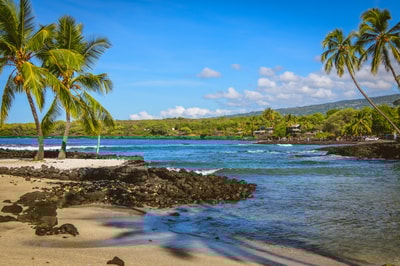
The sand is lava, ground into a dark cove, and green sea turtles haul out on it to bake. Coconut palms lean over that shoreline. This is the stop between the national park and the Kona side. Most people watch the turtles, walk the beach, and move on, and if you want the night, Hawaii County requires a camping permit, and you buy it before you arrive.
For the other islands, start on the Hawaii campervan page.