






The season here is short and hard-edged
Wisconsin's camping season is genuinely bounded, and a van with an onboard water system feels that more than a tent does. At Devil's Lake State Park, running water and showers are typically closed and locked from about October 15 to April 15. Two of the park's three campgrounds, Northern Lights and Ice Age, usually close in October and reopen around April; only Quartzite stays open year-round. Lake Kegonsa, the nearest state park campground to the city, notes that its flush toilets and showers may close in early May and late October depending on weather.
Read together, that puts the practical window for a van you intend to keep watered at roughly late May through early October. Outside it you are dry camping and hunting for somewhere to fill and dump, which is when a list of national forest campgrounds open year-round starts to earn its keep.
If you point the van north early in the season, black flies are the bug that surprises people. Populations in the wetter parts of the northern Great Lakes, including Minnesota and Michigan's Upper Peninsula, swell from late April into July. The larvae need running water, so the trout streams and rapids that make the north woods worth visiting are exactly where the flies are thickest.
Two separate fees at every state park
Wisconsin requires a vehicle admission pass on every motor vehicle stopping in a state park, forest or recreation area, and that includes driving into a campground. It is separate from the campsite fee, and booking a site does not include it.
Passes come as a daily or a 12-month sticker, and out-of-state plates pay a higher rate than Wisconsin plates. Without a 12-month pass you need a daily pass for each night you camp. The pass must correspond to the vehicle's plate, and the DNR states plainly that a rental with out-of-state plates has to buy the nonresident pass, so check the plate rather than assuming you qualify for the resident rate.
Reservations run through GoingToCamp, 11 months out
Wisconsin does not put its state parks on recreation.gov. Bookings go through wisconsin.goingtocamp.com or 1-888-947-2757, and the window is 11 months, with the date 11 months away released at 9 a.m. Central each morning.
Devil's Lake is where that window actually bites. It is the most-visited state park in Wisconsin, drawing over 2.5 million visitors a year, and the DNR is blunt about the consequences: parking lots often fill before 9 a.m. on weekends and holidays from May through October, and once they do, access to the park may be temporarily restricted until congestion eases. A campsite reservation is also your reliable way in. If you have flexibility, the DNR suggests Monday through Thursday.
Where a van actually goes from Madison
Devil's Lake, about 40 miles northwest
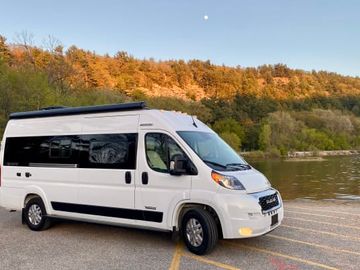
Under an hour from the city. Quartzite bluffs rise 500 feet over a 360-acre lake, with close to 30 miles of trail. The park also carries a stretch of the Ice Age National Scenic Trail, which runs nearly 1,200 miles across Wisconsin. Of the three campgrounds, Quartzite (sites 1 to 100, 75 with electric) is the open, spacious one with a dump station. Northern Lights (143 sites, 71 electric) is the wooded electric option. Ice Age (235 sites) has neither electric nor a dump station.
Wisconsin Dells, about 55 miles north
Worth naming honestly: the Dells is the region's commercial camping cluster, a dense run of waterpark resorts and private RV parks. It is not wilderness and does not pretend to be. It is, however, where full hookups, laundry and showers are easiest to find within an hour of Madison, and it sits about 20 miles from Devil's Lake, so it doubles as a fallback when the state park is full.
The Driftless Area, roughly 100 miles west
The most geologically distinctive drive out of Madison. The Driftless Area was never covered by ice during the last glacial period, so it kept its pre-glacial drainage and never received the flattening layer of glacial drift that shaped the rest of the Midwest. The result is steep hills, forested ridges and deeply carved river valleys, and roughly 85 percent of it lies in Wisconsin's southwestern quarter. Wyalusing State Park lets you camp about 500 feet above the confluence of the Wisconsin and Mississippi rivers, with 109 regular sites and a dump station near the entrance to the Homestead campground.
Allow more time than the mileage suggests. This is ridge-and-valley two-lane road with real climbs and descents, not interstate.
Door County, roughly 185 to 210 miles northeast
Sturgeon Bay sits at the base of the peninsula; the shoreline towns most people are actually aiming for are another 25 miles up. Peninsula State Park is the camping anchor, with 468 family sites across five campgrounds and about 151 electric sites. Tennison Bay (188 sites, 97 electric) and South Nicolet Bay (143 sites, 54 electric) carry most of the electric. The sanitary dump station is on Shore Road just east of Tennison Bay and operates May through October. Same reservation system, same 11-month window, same summer-weekend pressure. It is also far enough out that some people start from campervan rentals in Green Bay instead.
Farther north, for a week rather than a weekend
Apostle Islands National Lakeshore, headquartered in Bayfield on Lake Superior, is about 325 miles north of Madison. Pictured Rocks, at Munising in Michigan's Upper Peninsula, is roughly 300 miles. Both are full-day drives rather than weekend runs, and both put you squarely in the early-summer black fly window if you go in June.
Pickup and getting clear of the city
Dane County Regional Airport (MSN) is about seven miles northeast of downtown, with rental counters across from baggage claim. It is Wisconsin's second-busiest commercial airport and still small enough that pickup tends to be quick.
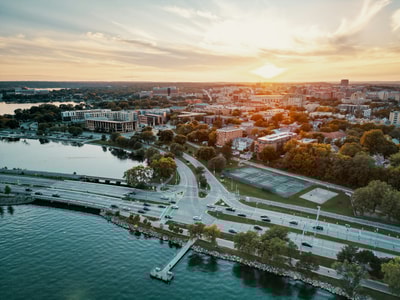
Madison itself is the constraint. Downtown sits on a narrow isthmus between Lake Mendota and Lake Monona, hemmed in by water on both sides, with a dense grid around Capitol Square and the university campus. Plan to base the van outside the isthmus and see the middle of the city on foot or by bike.
One scheduling note: Camp Randall Stadium seats over 76,000 and sits on the university campus just west of downtown. Home football Saturdays in the fall are the wrong day to schedule a pickup or a return through the middle of Madison.