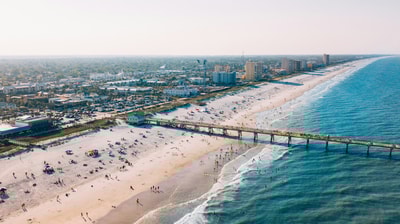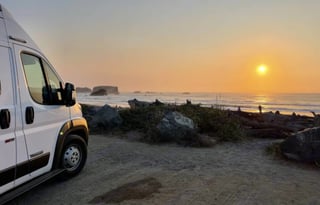
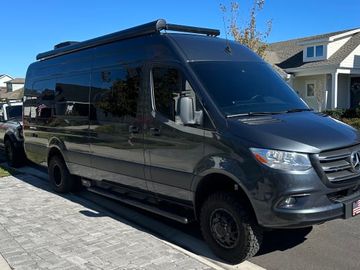
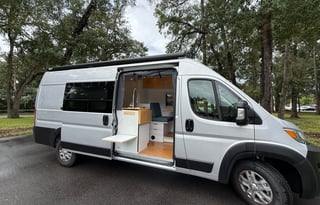
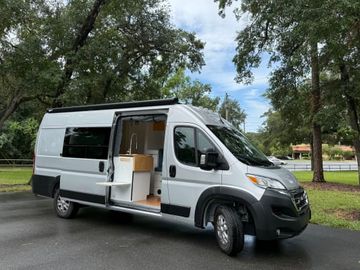
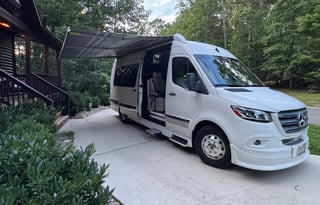
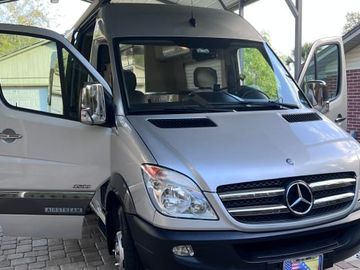
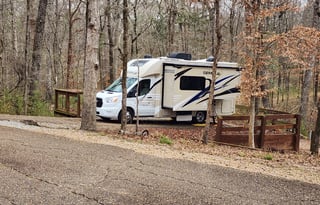
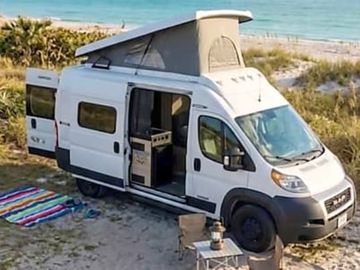
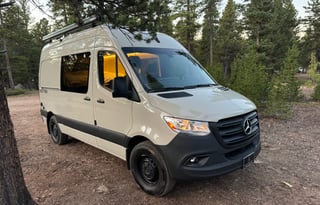
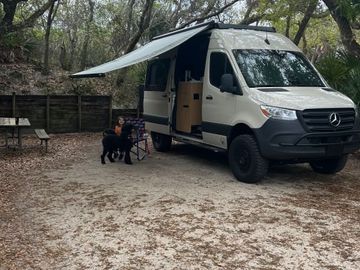








Give the first night to Little Talbot Island, and get that night before you get the van. The campground sits back in maritime hammock, live oaks and holly and southern magnolia grown up over old dunes, and the beach is about a half-mile walk from the sites. That side of the island is undeveloped the whole way, so the walk ends in dunes and open sand instead of a parking lot. It is a small campground, the summer weekends go long before most people start pricing a rental, and the van is the half of the trip you can still shop around for.
RV length at Little Talbot tops out at 30 feet, which is what decides who gets in, and a campervan clears it without thinking about it. Sites carry 20- and 30-amp electric with fresh water, a fire ring and a picnic table, two bathhouses have hot showers, and the dump station is at the campground exit rather than at the pads, so you empty on the way out.
The reservation window opens 11 months ahead for Florida residents and 10 months for everyone else, and that 30-foot cap thins out what is competing with you for a pad.
Florida State Parks puts full-facility camping at $24 a night plus tax, with a nonrefundable $6.70 reservation fee and a $7 nightly utility fee on RV units, as of August 2026. Day entry is $5 a vehicle and the gates run 8 a.m. to sunset.
Myrtle Creek runs behind the island through the marsh, and the launch there is tidal, so the current picks your direction going out and your timing coming back. Go out with the water and come back with it and the paddle is easy in both directions. Fight it and it is a different afternoon.
Dogs travel well here up to a point. They are welcome on a leash in the campground, on the trails and on the paved areas, and they are not allowed on the boardwalks or the beach, so the beach walk is the one part of the day somebody stays back at the van.
Kathryn Abbey Hanna Park when the state park is full
Hanna Park is the city of Jacksonville's own campground, 300 sites in the woods on paved roads with the ocean over the dunes. The city lists electric and water hookups, a dump station, restrooms with showers, a camp store, laundry and overnight security, with RV camping at $30 a day plus tax as of August 2026.
Reservations go through the city online, though its own page still describes the sites as first come, first served, so call before you drive out on a Friday and assume a spot is held. Tent camping is $18 a day plus tax and the rustic cabins are $30 a day plus tax on a two-day minimum, which is how a group that outgrew one van still sleeps in the same loop.
Mountain bike trails run through the same woods and the park rents kayaks and bikes, so a day you did not plan to spend here fills itself. The ocean is over the dunes on the east side, and the campground is far enough back in the trees that you are not sleeping in the wind off it.
Big Talbot Island and Fort Clinch, north up A1A
Big Talbot is the day stop next door. The island's east side is a bluff rather than a dune line, and it keeps giving way, so whole live oaks and cedars have come off the top onto Boneyard Beach and bleached out where they landed, standing in the surf like driftwood nobody could move. Park, walk down, and give it an hour.
Keep north on A1A and Amelia Island ends at Fort Clinch, brick walls out on the point with the Atlantic on one side and the river on the other. Going inside the fort costs $2.50 a person as of August 2026, and the park keeps campsites of its own, which makes it the overflow when everything closer to Jacksonville is gone.
South to Daytona Beach, west to Gainesville
South on I-95 the next coastal base is Daytona Beach. Inland to the southwest, Gainesville swaps the surf for spring water. North across the state line, Savannah is the same tidal creek and marsh country as the Talbots, and the Florida hub covers the rest of the state.