

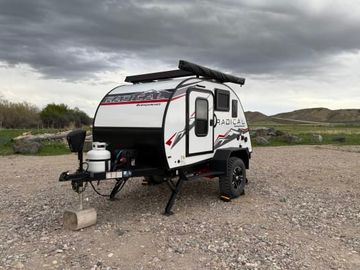
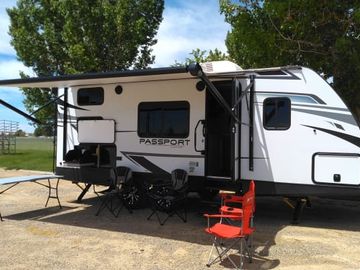
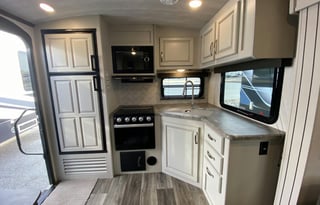
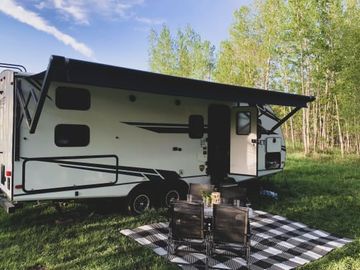
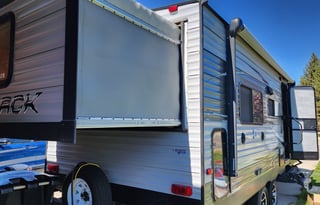
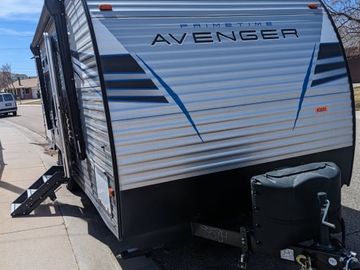
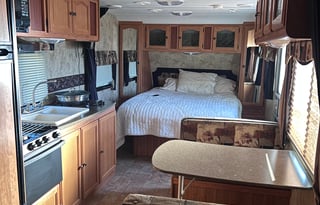
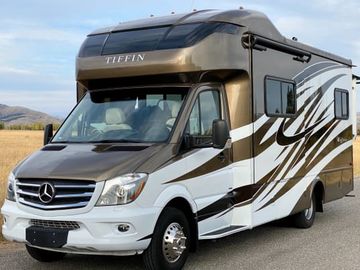
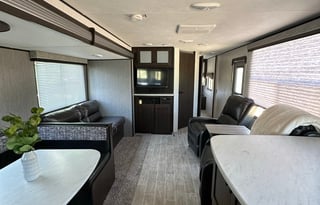
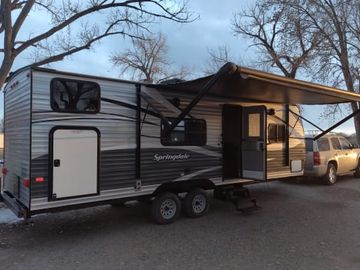








Motorhomes park facing the Wind River at Dubois for one last night before the road climbs toward Grand Teton and on into Yellowstone. Those two parks in one week are Wyoming's motorhome trip, and the rest of the state arranges itself around them. Devils Tower waits at the far end of a long drive east, and every July the rodeo pulls a second wave of motorhomes into the lots off I-25 at Cheyenne.
Fishing Bridge, the Grand Loop and Colter Bay
Longhorn Ranch in Dubois has river-front, big-rig and pull-through sites, and from the north or west the same last-night stop is a hookup park in Gardiner or West Yellowstone. Fill the fresh tank and empty the others before the gate, because the hookups mostly end there.
Inside, build the week around Fishing Bridge RV Park, 7,800 feet up where the Yellowstone River slides out of Yellowstone Lake. It's the only campground in Yellowstone with water, sewer and 50-amp electric at the site, and because this is grizzly country it takes hard-sided rigs only, with no tents at all. The season runs early May through mid-October as of September 2026, per the Park Service. Two or three nights there make a base for the lake and the Grand Loop, where a bison herd deciding to cross holds up every motorhome behind it until it's good and done.
The rest of the park's campgrounds are dry, and they decide what length of rig you can book. Caps on the Park Service campground table run from 95 feet at Fishing Bridge and 60 feet at Bridge Bay and Madison down to 25 feet at Lewis Lake, and the same page rules out overnight parking anywhere outside a campground. Lock the campgrounds first, then pick the motorhome that fits them.
From the lake the road runs south out of Yellowstone and into Grand Teton, where the rig side of the trip is the Colter Bay side of the park, the range lined up across the skyline. The same rule holds there, with no sleeping in the rig outside a campground. Campground-by-campground caps, the Grand Loop's grades and Colter Bay's pads are on the Yellowstone RV page, and the Jackson side of the Tetons is on the Jackson campervan page.
Devils Tower and the Black Hills side
Across the state in the northeast corner, the drive into Devils Tower National Monument puts the Tower in the windshield long before the campground, 1,267 feet of rock standing over the Belle Fourche River. A rig sleeps at Belle Fourche River Campground, the only place to camp inside the monument, with the Tower in view from most of the grounds. When it's full, the hookup parks in Sundance and Moorcroft take the overflow, and from there the road runs east into the Black Hills. The monument campground's length cap and the rest of this corner's pads are on the Gillette RV page.
The usual way over from Yellowstone is US-14 across the Bighorns, alpine meadows and lodgepole climbing to Meadowlark Lake, a no-wake lake with forest camps open roughly June to early September. Many of those sites are first come, with some reservable on Recreation.gov. If the trip is just two of you, the Bighorn camps, Wind River country and a smaller rig for the whole northern loop are on the Wyoming campervan page.
Cheyenne Frontier Days and Curt Gowdy
For ten days every July, Cheyenne Frontier Days turns the dry pull-through lots off I-25 into rows of motorhomes, with the rodeo-week crowd moving between them and the arena. It's the one week on the Wyoming calendar when the rodeo and ordinary summer trips chase the same rigs and the same pads, from the event lots to the lake camps outside town to the parks on the Fort Collins side for anyone coming north on I-25.
The rest of the summer, Cheyenne's rig weekend is Curt Gowdy State Park and its lake camps, reserved ahead except at Federal Bay and Hecla Point. There's no trailer dump station in the park, so empty the tanks at the free station at the Cheyenne welcome center on the way. The event week, the lake and the rest of town get the full treatment on the Cheyenne RV page.