













Deer graze out in the open meadow at Big Meadows while the lights of the Shenandoah Valley come on below the ridge. Getting up there means Skyline Drive, the crest road through Shenandoah National Park from Front Royal to Rockfish Gap, taken at the slow pace the road asks for. Bear and deer work the verge, the overlooks swing between the valley on one side and the Piedmont on the other, and in October the color runs down both slopes at once.
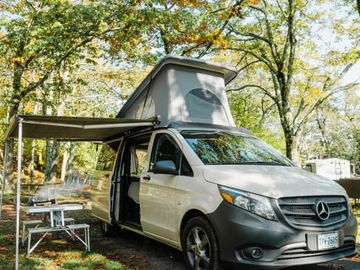
In a motorhome the week splits into two kinds of night. Up on the crest the campgrounds are dry, so the family lives off the fresh tank, the battery and the generator for two or three nights at a stretch. Down in the valley, a riverside park with full hookups at Luray resets everything before the next run along the ridge. The Shenandoah campervan page covers the drive itself as a smaller-rig trip.
Luray and the Shenandoah River below Thornton Gap
The easiest first night is down by the river at Luray RV Resort, on the US-211 side of the park, with the ridge you'll drive tomorrow standing over the pad. Its Pull-Thru Super Sites measure 60 by 85 feet and take large rigs, and every site has full hookups with 30 and 50 amp service, as of October 2026.
It also covers the late arrival, since the park has no overflow for a rig that reaches the gate after dark. From the resort, US-211 climbs straight to the Thornton Gap entrance, and the family can come back down to the same hookups between ridge nights.
Marys Rock Tunnel and the gates onto Skyline Drive
Heading south from Thornton Gap, the low arch of Marys Rock Tunnel comes up less than a mile in, and on a tall rig it looks lower the closer you get. The Park Service posts a maximum clearance of 12 feet 8 inches for both lanes, so measure the rig with the roof air conditioner before you pick a gate. For two people, a lower and shorter rig makes the tight spots easier, and the Virginia campervan page runs those smaller-rig trips, from the Grayson Highlands balds and the caverns under the valley to Cumberland Gap and Breaks Interstate Park.
The mileposts are worth knowing for that choice. Front Royal is mile 0, Thornton Gap is 31.5 with the tunnel at 32.2, Big Meadows sits at 51.2, Swift Run Gap on Route 33 is 65.5, and Rockfish Gap closes the Drive at 104.6. The whole road is open to RVs and trailers at 35 mph, with low gear on the descents, and it can close for weather at any point in the year.
Big Meadows and Loft Mountain, nights on the crest
Big Meadows is the night families aim for, a wide grassy clearing on top of the ridge with deer moving through it at dusk and the valley going dark below. Loft Mountain, farther south, is the second ridge night and the last before the Drive ends at Rockfish Gap. Two nights at one and a night at the other, with a run back down to Luray in between if the tanks need it, is a full week on the mountain.
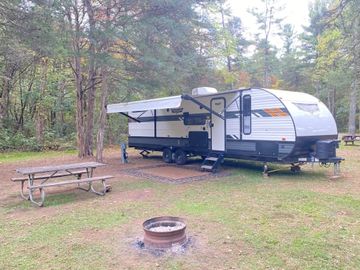
Big Meadows is reservation only through Recreation.gov, with many sites opening up to six months out, so lock the pad before you book the rig. Loft Mountain mixes reservable and first-come sites. The Park Service describes Big Meadows with pull-through and deep back-in sites and Loft Mountain with deep back-ins, both handling most RVs and a tow vehicle, with no electric or water hookups and a dump station and potable water in season.
That makes the cadence simple. Fill the fresh tank and empty the others on the way into each campground and again on the way out, and the dry nights take care of themselves.
At Rockfish Gap the Blue Ridge Parkway picks up the same ridgeline and keeps going south toward Roanoke, with Claytor Lake on the New River waiting as a lake week at the far end. The Roanoke RV page carries the Parkway's tunnel clearances and that lake.
Williamsburg, Hampton Roads and the Eastern Shore
East of the mountains the rig stops moving every day and settles into one park for the week. The Historic Triangle is the family version, with Colonial Williamsburg and Busch Gardens by day and the Colonial Parkway running out to Jamestown and Yorktown, all from a hookup park outside Williamsburg. The Richmond RV page has those parks and the week around them.
Closer to Yorktown, the city campground at Newport News Park makes a base for the battlefield and Jamestown days, and the Hampton RV page covers its pads and what the Colonial Parkway allows a rig. At the ocean end of Hampton Roads, a private park behind the beach and the trolley to the boardwalk make the easy summer week, and the Virginia Beach RV page has the parks.
Out of Norfolk, the Chesapeake Bay Bridge-Tunnel carries the rig across the mouth of the bay to the Eastern Shore and a parked week near Cape Charles. Wind and the bridge-tunnel's rules for high-profile vehicles both matter on that crossing, and the Norfolk RV page covers them.
Coming down from Washington, I-95 runs past Fredericksburg toward Richmond, with the hookup campgrounds on Lake Anna's private shore just west of it. The Fredericksburg RV page carries that lake week and the long one-way run south along I-95.