

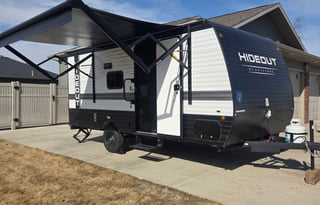
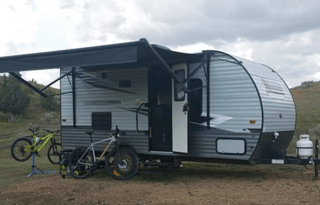
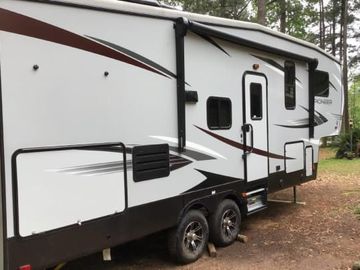
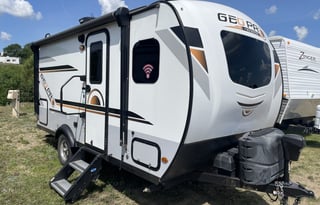
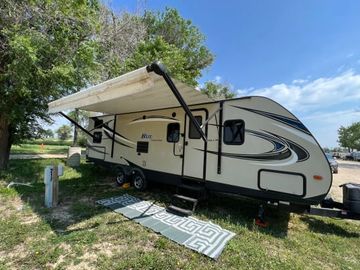








A row of motorhomes lines the bank of the Little Missouri River in Medora, looking across the water at buttes gone gold in the late light. The badlands of Theodore Roosevelt National Park's South Unit start where the town ends, so a whole week can run out of one riverside site: into the park after breakfast, back to the river for dinner, out again the next morning. That's the rhythm a rig settles into here, with a night or two out among the buttes once everyone knows the roads.
That riverside row is Medora Campground, and its sites carry water, sewer and 20- to 50-amp electric, as of October 2026. Sites are sorted by length, with the long 50-amp pads meant for rigs of 35 feet or more, the short 50-amp pads for 34 feet or less, and the long 30-amp pads for 32 feet or less. Book the site before you book the rig, because the pad you land decides which motorhome fits it.
The South Unit scenic loop, Cottonwood and Juniper
The South Unit's scenic road is the day out, winding from Medora up through the buttes and back down toward the river. The Park Service says it takes large RVs and trailers if you go carefully, since it's narrow, with sharp curves and steep grades. If that sounds like a lot of road for a 30-footer, or it's just two of you, the same badlands trip on smaller wheels is on the North Dakota campervan page.
For a night inside the park, Cottonwood Campground spreads across a cottonwood flat in the South Unit about 5 miles from Medora. From mid-May to mid-September it's full by every afternoon, and it takes reservations up to six months out, so lock those nights in before the rig, along with the Medora site.
None of the park's campgrounds has hookups or showers. Leave Medora with the fresh tank full and the waste tanks emptied at your site's sewer connection, and plan the next one for when you're back in town or at the dump station below Garrison Dam.
Hwy 85 heads north to the park's North Unit and its own stretch of badlands, where Juniper Campground is the only place to camp, 5 miles from the highway. It's reservation-only and dry like Cottonwood. A week that strings Medora, Cottonwood and Juniper together before heading east to the Missouri gets a hookup night on each end of its dry stretch. Summer brings highs from 80 to 100 with wind and thunderstorms, so the awning comes in before you leave the site for the day.
Lake Sakakawea and the Missouri below Garrison Dam
Below Garrison Dam the Missouri leaves Lake Sakakawea and runs through a forest of cottonwoods, with sand dunes piled along the riverbank. Days go to the river and the big lake above the dam, and families from the middle of the state make it a regular weekend.
Downstream Campground sits in those trees on paved roads and paved sites, with three loops, 98 electric sites, 16 primitive sites and showers. Reserve an electric site before anything else, because that's what turns a weekend into a parked week. The campground's fill and dump station is also the place to reset the tanks after dry nights in the badlands.
Grahams Island on Devils Lake for a parked week
Devils Lake has a thickly wooded shore, and Grahams Island State Park tucks big shaded campsites into that cover. The park hosts national and regional fishing tournaments, and on those weekends the lake edge fills with anglers.
The rig angle is the full-hookup loop. Grahams Island's 45 premium sites have electricity, water and sewer, so a family can stay put all week without a dump run, while the 70 modern sites have electricity and water with a dump station in the park. Summer weekends go as soon as the booking window opens. The campground also stays open after most others around the lake close for the season, which makes it the fall pick.
The campervan take on Devils Lake lives on the North Dakota campervan page, along with the wooded Turtle Mountains, the International Peace Garden on the Canadian border, and the deep valley of the Pembina Gorge in the far northeast. At the state's eastern edge on the Red River, Fargo has its own RV page built around Bison football Saturdays and the Corps campgrounds on Lake Ashtabula.