

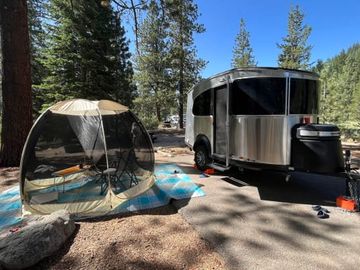
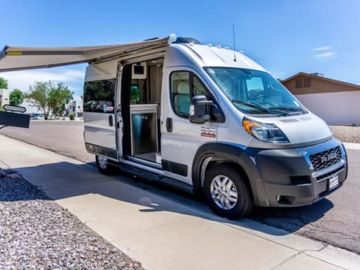



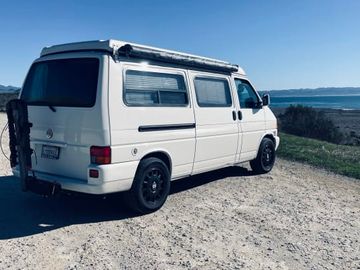

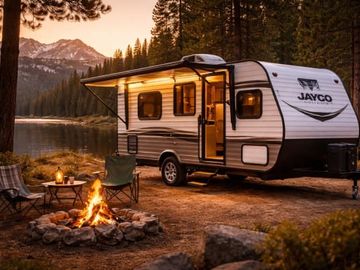

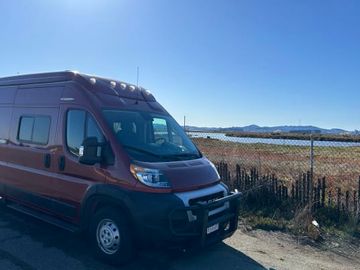








A week down the coast from San Francisco is easiest when nobody has to drive it back. You leave the Bay on US-101 through the Salinas Valley farmland, spend the first evening at Pismo Beach with the surf a few rows off and the coastal hills going dark behind the rigs, then roll on past Santa Barbara to the white sand and rock outcroppings at Carpinteria. By the last morning the traffic thickens past Ventura, and Los Angeles is where the road and the week both run out.
A motorhome fits the shape of it. The miles come in long inland stretches between nights at the water, the kitchen travels with you, and nobody unpacks a suitcase until Los Angeles.
Pismo Beach, Carpinteria and the coast into Los Angeles
Highway 1 through Big Sur is the cliff road everyone has seen, hanging over the Pacific south of Carmel, and in a rig it's a daylight run with the turnouts for stopping. As of September 2026 the Big Sur state parks (Point Sur, Andrew Molera, Pfeiffer Big Sur and Julia Pfeiffer Burns) are closed after the Timber Fire, so nobody sleeps there. The first day ends at Pismo either way. Straight down US-101 it's about half a day of driving, or the whole day if you swing out to the coast for Big Sur.
Pismo Beach is wide and flat, with the dunes running south and the salt air coming in over the sand at dusk. Pismo Coast Village sits right behind the beach, rows of rigs under the coastal hills with 400 full-hookup sites on 30 and 50 amp, and it's the night to empty the tanks and fill the water. If it's full, Morro Bay State Park a little way back up the coast has hookup sites and a dump station within sight of Morro Rock. The Costa Mesa RV page has the pads at all three and their length caps.
Day two stays on US-101, which comes back to the ocean north of Santa Barbara and follows the Santa Barbara Channel down the coast. Carpinteria State Beach is the night at the end of it, white sand running out to dark rock outcroppings, and the park has RV sites with hookups and a dump station, the second place on the drive to empty the tanks. If you'd rather have a towable delivered and set up on a site there, check the listing before you book, since the park lets only one approved company deliver trailers onto the grounds.
In summer, reserve Pismo Coast Village and Carpinteria before you book the rig. Those two nights set the dates, and a longer stay at either one stretches the week without changing the route.
From Carpinteria it's the last run on US-101 through Ventura into Los Angeles. Cruise America runs one-ways between its locations, so the rig can go back at its Carson hub, and El Monte RV's one-way program covers same-state routes out of San Francisco, with a branch at LAX.
Humboldt Redwoods and the Avenue of the Giants
Pointed north, US-101 climbs through Sonoma and Mendocino counties to the old-growth redwoods of Humboldt. Humboldt Redwoods State Park, which State Parks describes as the largest remaining old-growth redwood forest in the world, carries the 32-mile Avenue of the Giants beside the highway, a two-lane road under trunks so wide the afternoon light comes down in columns onto the river flats.
Burlington, the campground on the Avenue itself, puts the rig among the big trees for the night, and the park's campsites open for reservation six months ahead, so lock the site before the rig. As of September 2026, State Parks has prescribed burns planned in Humboldt Redwoods, which is worth checking before a fall trip. Summer brings fog to the coast, and winter brings rain to US-101 north.
The Mendocino coast is the detour west on the way up, and the Russian River and the Sonoma Coast closer in belong to the Santa Rosa RV page. Point Reyes is nearer still, and Samuel P. Taylor's redwood campground beside it is a small-rig campground, so that trip, along with Half Moon Bay and the Marin Headlands, is on the San Francisco campervan page.
East, the long drives run into Yosemite and the Sierra and on to Las Vegas or Salt Lake. The California RV page covers the big-rig approaches and the in-park limits.